how to make a Spruce root basket
In the old forests, the materials for everyday life are never far away. What might look like a tangle of roots or a thicket of saplings can, with care and patience, become the frame of a basket sturdy enough to gather food, carry kindling, or simply connect us with an older way of working. Among the most dependable of these materials are rowan and spruce: rowan, with its straight, flexible stems, and spruce, whose roots have long been prized for their strength and pliability. Together, they provide the bones and sinew of a basket built to last.
This guide walks through the process of making a simple frame basket using hoops of rowan and the split roots of spruce. It is not only a set of instructions, but an invitation to notice the qualities of the plants themselves, the time of year when stems bend most easily, the way fresh roots peel clean after steaming, the rhythm of wrapping a God’s Eye weave to bind two hoops into a cross. Crafting with gathered materials asks us to slow down, to learn from the woods as much as from our own hands, and to carry forward traditions shaped by necessity, patience, and respect.
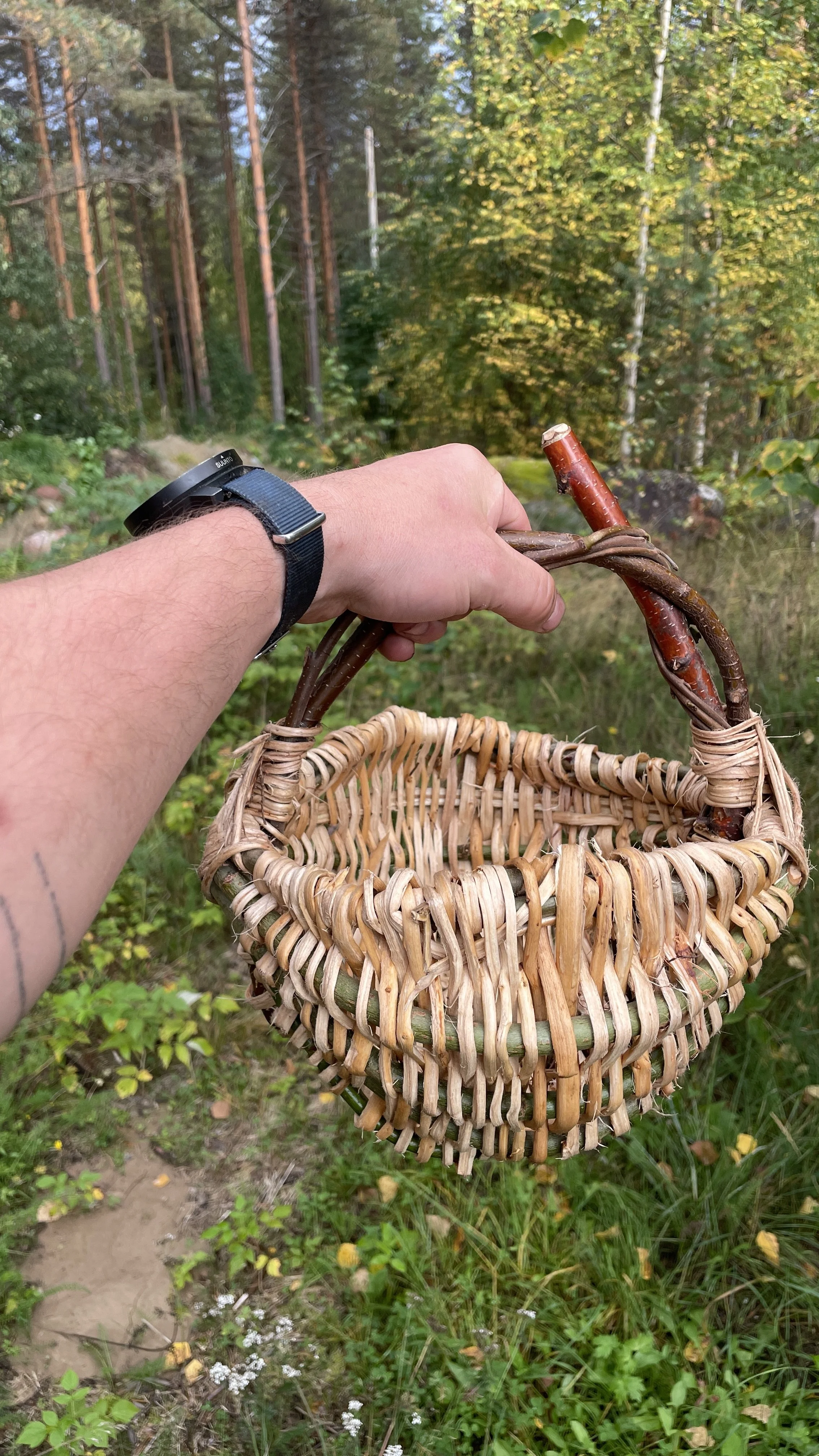
Planning & Harvesting Materials
Rowan or Birch stems for the hoops
Seek young rowan branches (stems) that are straight-ish, flexible, and of a diameter you can comfortably bend without snapping.
Spruce roots for the weavers / God’s Eye weave
Find fresh roots of spruce, young, pliable; pencil‑thickness or a bit more.
Clean them: remove bark, dirt.
Split lengthwise if needed, to get thinner, flatter strips for weaving.
Making the Hoops
Choose two rowan stems of similar size. Bend each into a hoop. Depending on the thickness, you may need to soak them first or heat slightly (over steam or low fire) to make them pliable.
Wrap the long lengths over and through themselves to form a hoop
Let the hoops settle: ideally let them rest so that they don’t try to spring back too much once worked.
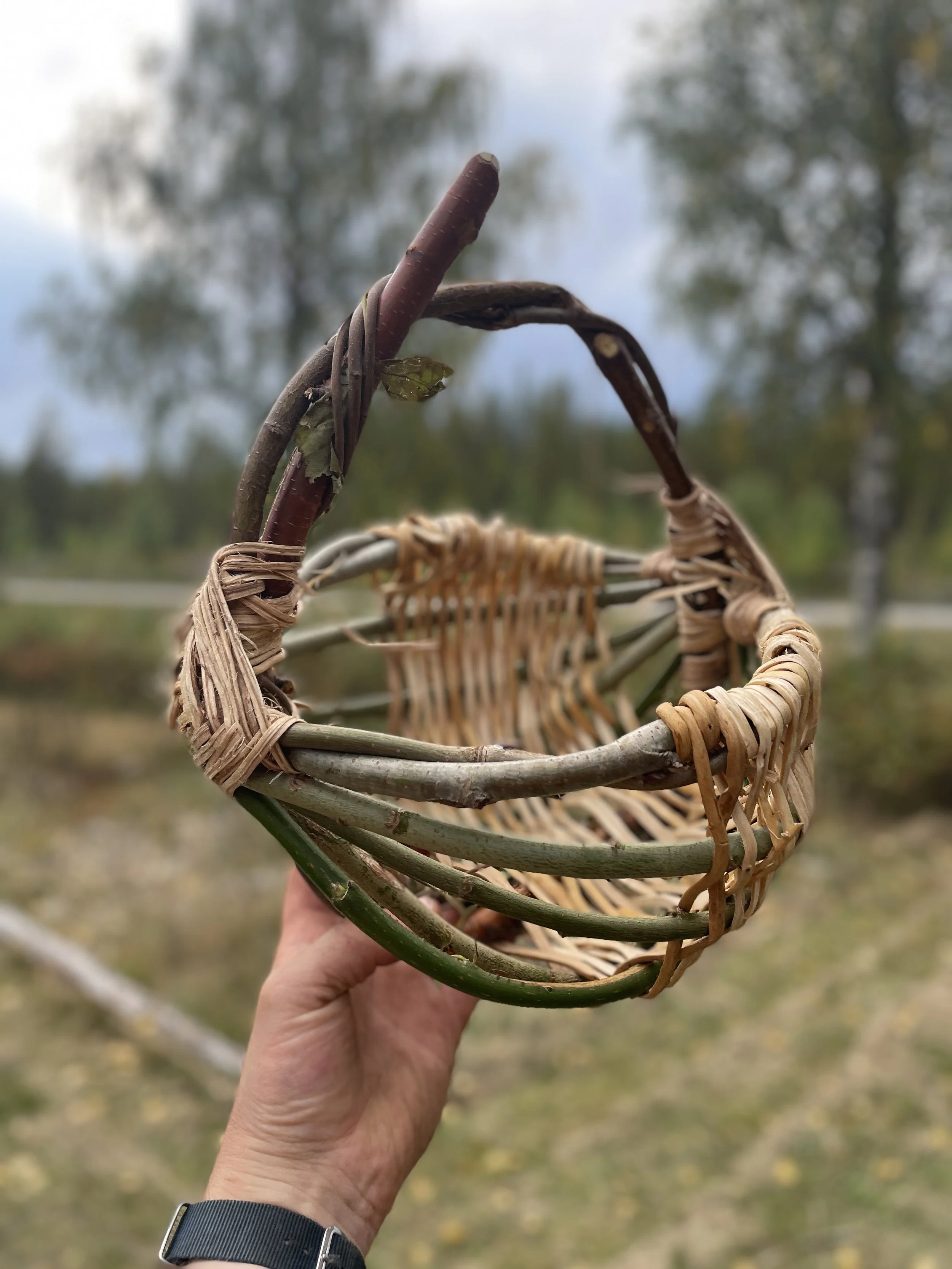
Setting Up the Frame: Crossed Hoops
Place the two hoops so that they cross one another (usually at right angles). One of the hoops will become the rim and the other the handle depending on how you want to carry or use the basket.
Where they cross, they must be tied together securely. This is where the God’s Eye weave comes in.
Finding and Selecting Spruce Root
First thing: look for young, flexible spruce roots. These are often found near the base of spruce trees, extending out beneath duff and moss. You want roots that aren’t too thick, pencil width or a little less is good. Fresh roots are best; if they’ve been exposed or dried out, they’ll be brittle but you can soak them for an hour or so to make them pliant again.
Processing the Roots
Once you've harvested the roots, there’s work to do before weaving.
Cleaning: Remove soil and any bark that comes off easily. Sometimes you’ll need to shave off rough patches.
Soaking / Steaming: To make roots pliable, soak them in clean water, perhaps warm, for some hours. In some traditions (such as among coastal Native basket‑makers), they’ll even boil or steam them briefly to loosen the fibres. This helps strip or peel the outer bark more easily.
Stripping / Peeling: Pull off the bark (or bark layer) and get to the inner root material. The outside bark side will have a nicer tannin colour; the inner side is paler and smoother.
Splitting: Split your root lengthwise to get narrower strips or “weavers.” You might start with halves or quarters, depending on diameter. Use a knife for the initial cut, then refine by hand: pulling with thumbs and using fingers or perhaps a thumbnail to clean up the split. The aim is relatively even strips, flexible but with enough strength.
Weaving the God’s Eye
A “God’s Eye” is a binding / lashing that holds two crossing hoops together, creating a stable centre from which to start building the basket frame. It also forms pockets into which the ribs can be inserted.
Steps:
Use your prepared spruce root strip (or several strips, depending). Fix one end at the intersection of the two hoops.
Wrap over one hoop, then under the other, then over, etc., moving around the four “arms” of the cross in a repetitive pattern. The idea is to wrap so that you bind the two hoops tightly together, covering the cross centre in overlapping wraps.
You can do several rounds of this wrap: once you complete one full wrap around, continue another; this builds up strength and width.
Ensure tension is even as you wrap; pull gently but firmly. The resulting God’s Eye should be neat, flat, and strong enough that the intersection doesn’t twist or shift as you add ribs or start weaving.
Adding Ribs & Building the Basket Body
Once the God’s Eye is done, insert ribs into the pockets you’ve formed by the weave. The ribs might be more rowan, hazel, willow, or even thicker spruce roots, depending on what you have. They run from one hoop to the other, forming the skeleton.
Position them symmetrically. If making the basket deeper, you’ll need more ribs; fewer for shallow baskets.
Start weaving between the ribs, using the spruce root weavers: over one rib, under the next, around the hoop, down to the other side, etc. Keep your weaving tight and even.
As the body grows, maintain the shape: if the ribs are far apart, the weave might bulge or sag; you may need to add ribs or adjust tension.
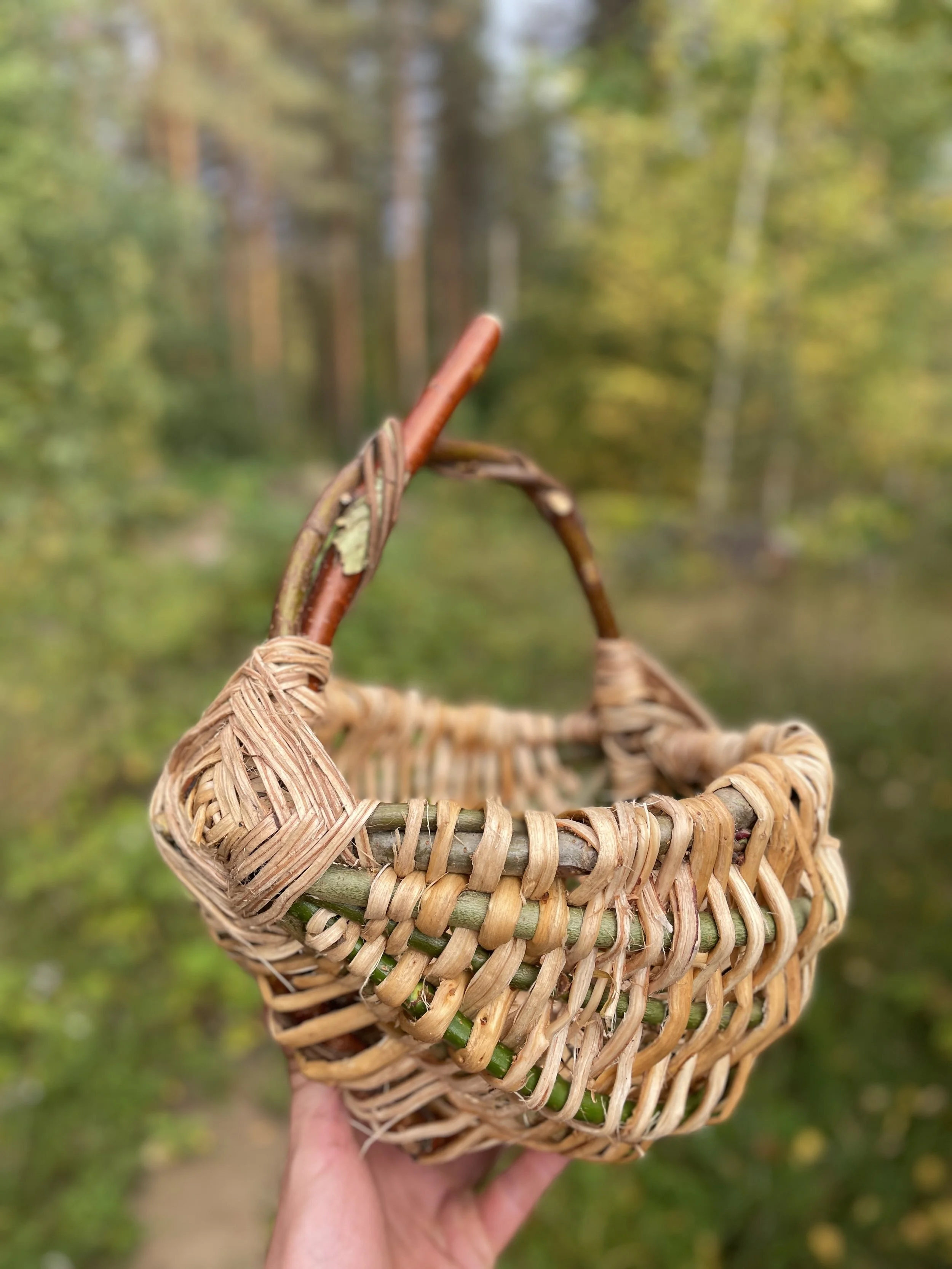
Drying, Use & Care
Let the basket dry slowly (in shade, with moderate humidity) so that the materials don’t crack.
Store somewhere dry; avoid direct sun or very dry heat that can warp or crack the spruce root.
Reflections & Tips
The God’s Eye weave is both functional (holding the two hoops rigidly together) and beautiful—once you see that cross‑woven pattern, it becomes a focal point.
Splitting spruce roots will makes a big difference: smoother, thinner weavers are easier to work with; you’ll get tighter weaving and less breakage.
Take your time; much of the craft is about patience. Respect for the materials (rowan, spruce) and the forest from which they came makes the process meaningful.
Even if the basket ends up a little wonky - or imperfect - that’s part of the learning. The character comes with those small deviations.