Night Navigation
…a journey of a thousand lights begins with a single step…
Step One
A few months ago, a fellow bushcraft instructor recommended Tristan Gooley’s books on natural navigation. I devoured them all within a few weeks. As I read, I seized every opportunity to get out into nature and put my newfound knowledge to the test.
During a bushcraft masterclass event in the Netherlands, where I was teaching several courses, I was fortunate enough to have the time to join Jamie Dakota on a natural navigation walk. Over the course of four hours, Jamie explained how to navigate the landscape using the sun, the wind, and the growth patterns of trees, plants, and mosses. Along the way, he had the participants apply what they were learning through a series of engaging and entertaining exercises.
Back at base camp, it was clear: my coming year would be dedicated to natural navigation. To make the challenge even more compelling, I decided to focus specifically on night navigation, simply because it was my greatest blind spot. It was an area ripe for discovery and wonder, and I would like to take you, the reader, along on this journey.
The Movie of the Stars
In a series of five articles, I will take you on a journey among the stars. Beside sharing fascinating information, I want to introduce you to some of the myths associated with various constellations and challenge you to seek them out for yourself while you’re outdoors. Stories are unfolding right above your head, all you have to do is look up. As a bonus, this celestial feature film is completely free of charge… (#ProudToBeDutch)
I have structured this five-part series to include a brief introduction, followed by a section for each of the four seasons. As you likely know, our perspective of the night sky shifts as the Earth orbits the Sun, meaning some constellations are only visible during certain times of the year. Consequently, the constellations currently in view can tell you which season it is. But it gets even better: these same constellations can tell you which direction you are facing. Nature is even kind enough to project a clock into the sky each season, allowing you to tell the time!
The North Star
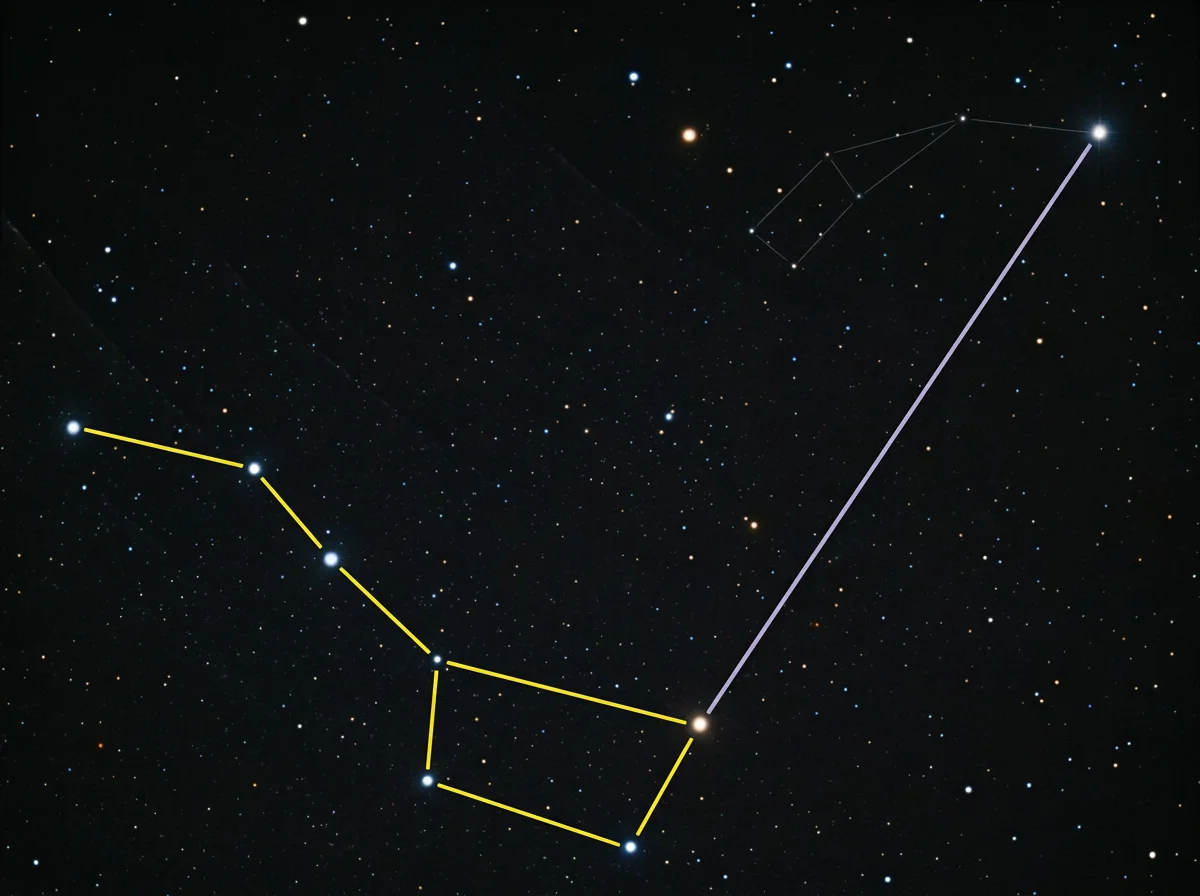
Polaris is part of the constellation Ursa Minor (the Little Bear). Many people might more easily recognize it as part of the "Little Dipper",an asterism, or a recognizable pattern that is not an official constellation. The North Star sits within one degree of the north celestial pole and remains visible year-round, making it a useful tool for nighttime navigation. Due to the precession of the equinoxes, the star we identify as the North Star changes over time. While Polaris holds the title today, around 3,000 BCE, that role was filled by Thuban (in the constellation Draco) and in just under 13,000 years, Vega (in the constellation Lyra) will take on this role.
Finding the North Star using the Big Dipper
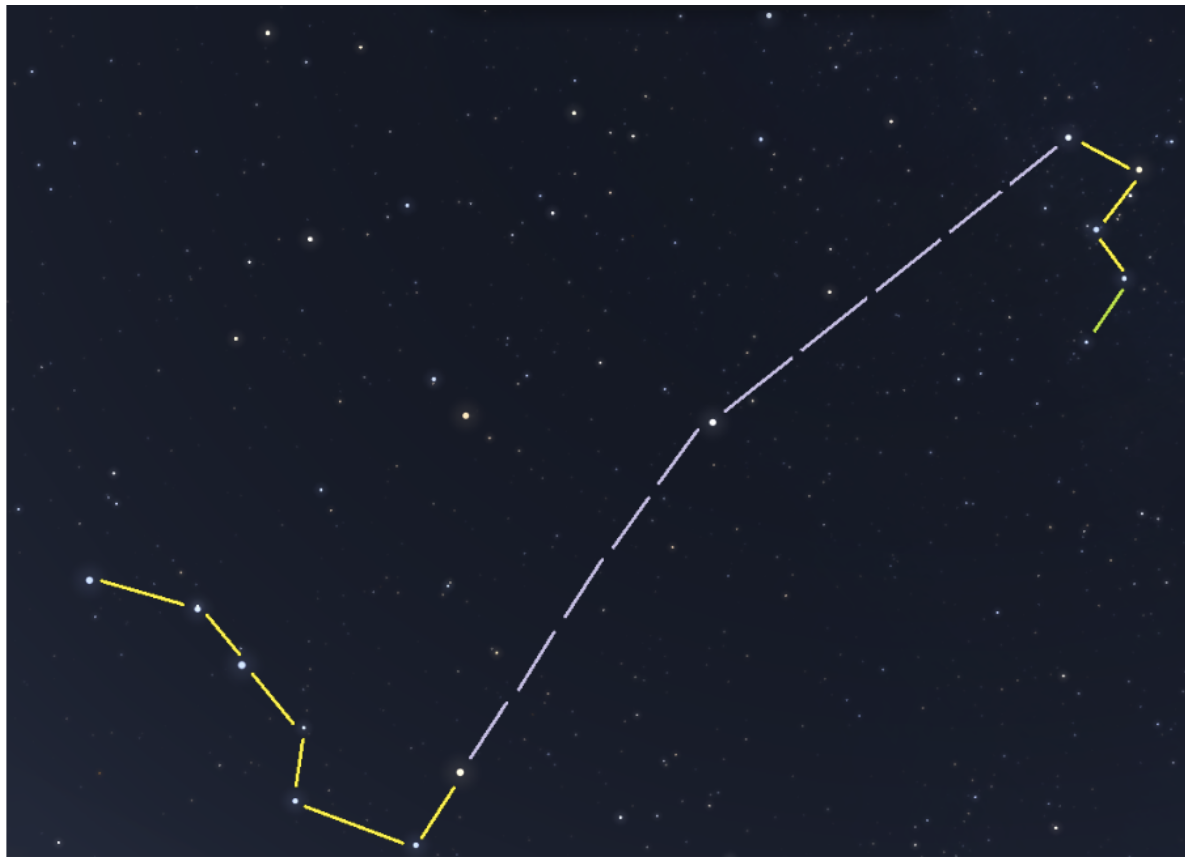
Once you have located the Big Dipper, you can use the two stars furthest from the handle of the dipper to find the North Star (Polaris). Have you found them? Imagine a line extending from these two stars, if you extend that line to a length five times the distance between the two stars, you will arrive at Polaris.
Telling time with the stars
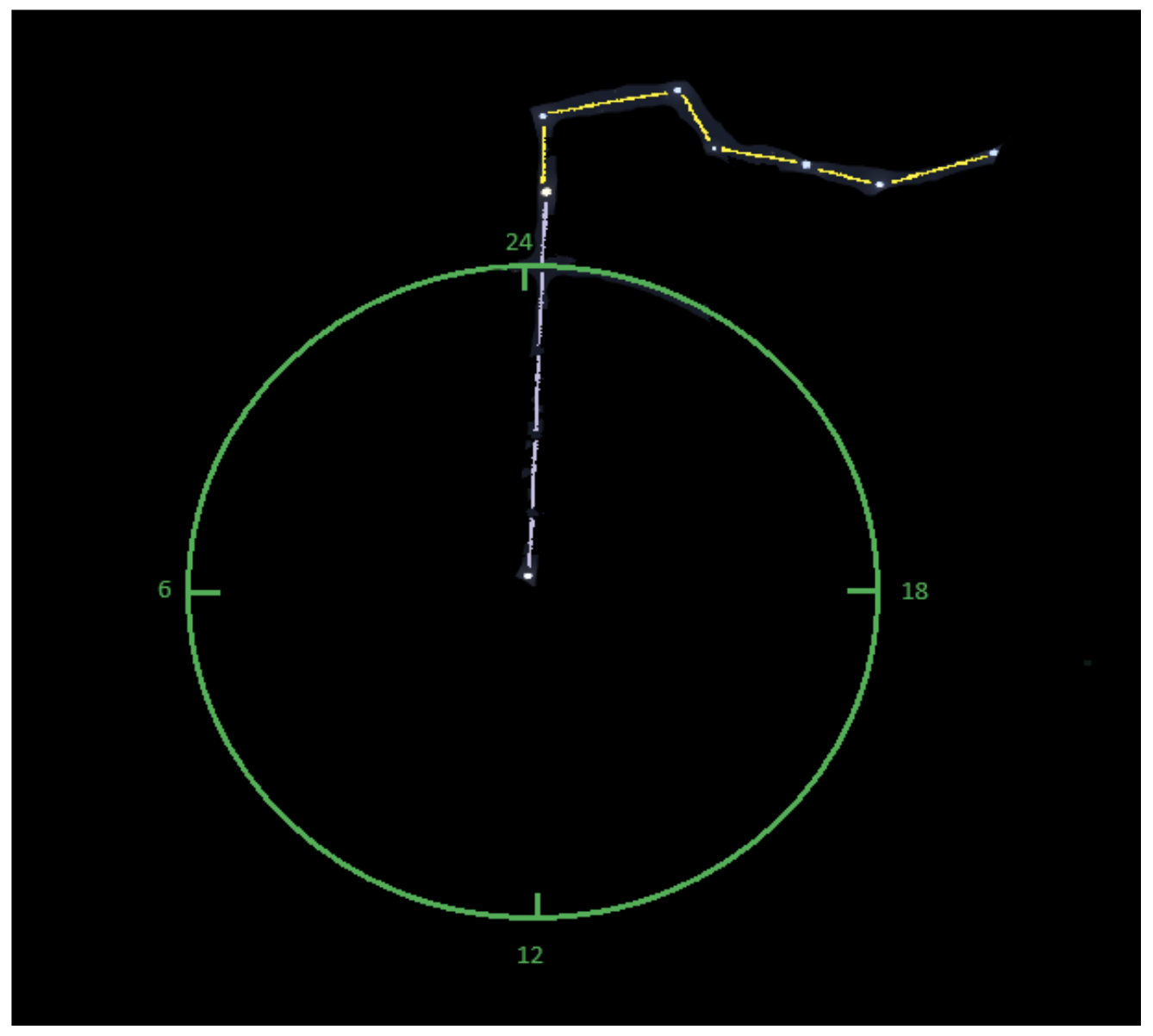
Now that you have found the Big Dipper and Polaris, you can use them to tell time! The Big Dipper rotates counterclockwise, acting as a celestial clock that indicates the time in hours. On March 6th, this celestial clock shows the exact time. This serves as a reference date; for every month thereafter, you subtract two hours from the reading to estimate the current time. Use this formula: Big Dipper time – (2 x number of months since March 6th).
On November 6th, while with some students, I observed the outer stars of the Big Dipper pointing to 12:00. Since this date was exactly 8 months after March 6th, I subtracted 16 (2 x 8) from 12:00, which gave me a time of 20:00 (8:00 PM). A quick check of our watches confirmed the time.
Keep in mind that you may need to account for daylight saving time! This period lasts from the last Sunday in March to the last Sunday in October; during this time, you should add one hour to the calculated end time.
The Milky Way
The luminous band visible in the night sky is the galaxy in which Earth orbits. It is estimated to contain between 200 and 400 billion stars. Although that may seem like an incredible number, our galaxy is only of average size. For comparison, there are giant galaxies that contain as many as 100 trillion stars!
According to First Nation legend, the Fire God took the stars from his blanket one by one, breathed life into them, and patiently placed them in the sky, forming constellations that could guide travelers. Coyote, known for his mischievous nature, watched from a distance but soon grew bored with how long the process was taking. He grabbed the Fire God’s blanket and tossed all the remaining stars into the sky at once, creating the chaotic star clusters that make up the Milky Way. Because not all of these stars had been breathed upon by the Fire God, they twinkle only faintly. When Coyote looked up, he realized he had forgotten to create a constellation for himself, which is why coyotes still howl at the sky at night.
The Royal Family
Once you have located the Big Dipper, you can determine the position of the "Royal Family" constellations by doubling the distance from the last two stars of the Big Dipper toward Polaris. Just below your end point, you will see a cluster of bright stars that form a W (in winter; or an M in summer) you have found Cassiopeia! Naturally, the same trick also works in reverse.
According to Greek legend, Queen Cassiopeia was always boasting that she was more beautiful than the Nereids (sea nymphs), prompting Poseidon to teach her a lesson by sending a flood and a sea monster named Cetus. An oracle declared that there was only one way to save the land: Cassiopeia had to sacrifice her daughter, Andromeda, to the monster. The girl’s father, Cepheus, tied her to a post to serve as bait. Just then, Perseus returned from his quest to slay Medusa. He rescued Andromeda, killed Cetus, and married the woman he had just saved. Poseidon, wanting to ensure that Cassiopeia had truly learned her lesson, tied her to her throne and placed her in the night sky, where she would circle forever, hanging uncomfortably upside down during the summer. Later, her husband, daughter, son-in-law, and even the sea monster would also appear in the heavens, ensuring the story would be remembered.
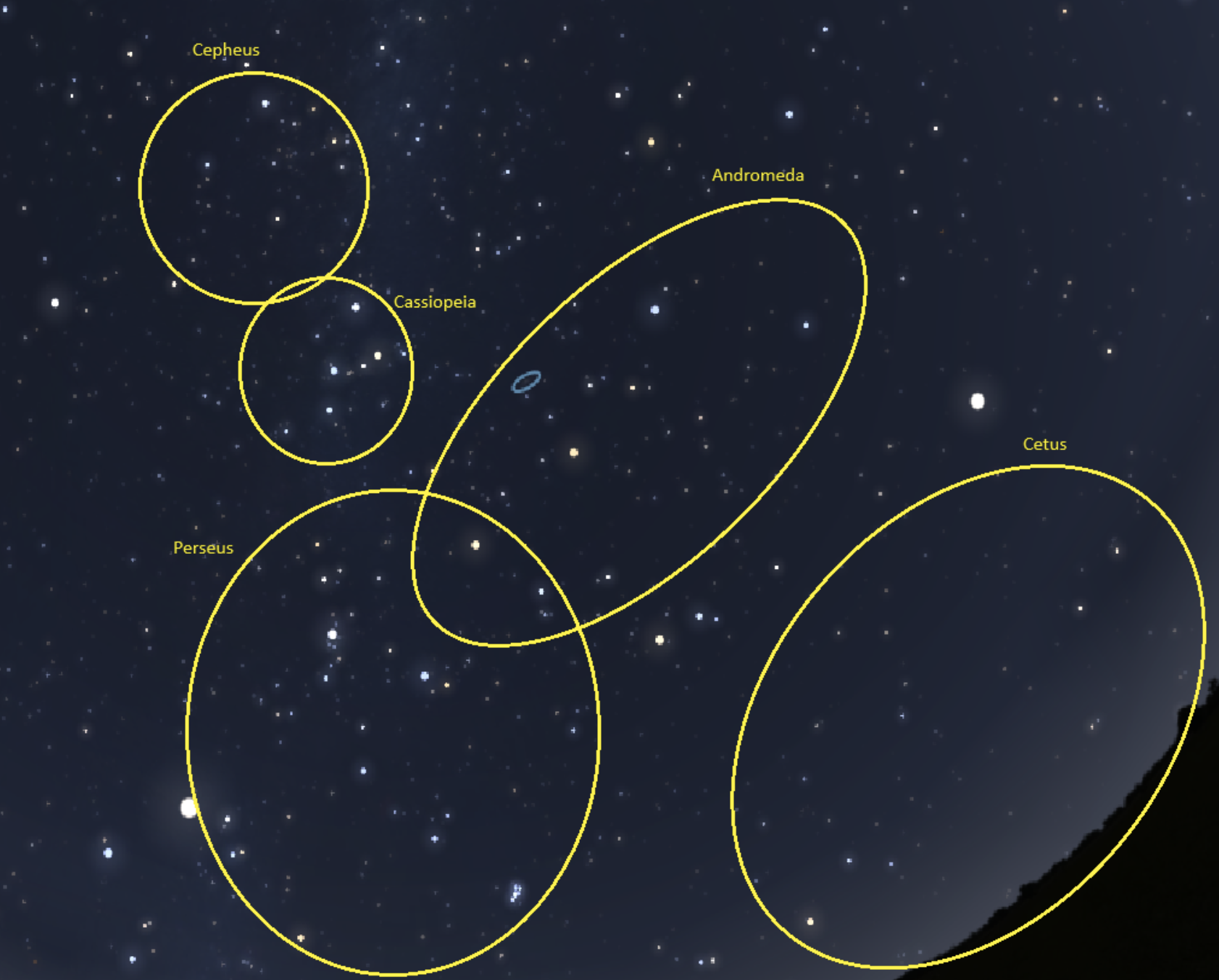
In the Northern Hemisphere, the "royal family" is visible throughout the year, but the sea monster is not.
As the saying goes, every journey begins with a single step. There is much more to share about what can be seen throughout the year, but I don’t want to overwhelm you with so many steps right from the start that you’re exhausted before you’ve even begun.
I invite you to head outside a few times over the coming month after dark and see if you can manage to tell the time using the Big Dipper, spot Cassiopeia, and locate the Milky Way. And perhaps you might even hear a sad coyote howling…
About the author
Peter Doornekamp, owner of Second Nature Bushcraft, teaches bushcraft and native skills in the Netherlands. Increasing the understanding that we are part of nature and rediscovering the deeper -and often weakened- connection with nature, our ancestors' knowledge, and ourselves are both his personal motivation and his teaching goals. Natural navigation, whether it is during daylight hours or the nighttime, is part of this connection.
Images
For more information and inspiration: